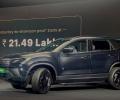
Tata Motors (TaMo) is aiming to gain market share across its passenger vehicle (PV) and commercial vehicle (CV) businesses - targeting a 40 per cent share in CVs and a 16 per cent share in PVs by 2027. Meanwhile, it has already achieved earnings before interest, tax, depreciation, and amortisation (Ebitda) breakeven in its electric vehicle (EV) business at 1.2 per cent (up 830 basis points), ahead of its target of 2025-26 (FY26).
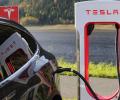
In 2024 alone, South India saw the highest rise in sales in the luxury segment, with Tamil Nadu reportedly registering a 19.3 per cent increase in premium car registrations from 2022-23

Only a few thousand chargers dot the Indian landscape, some in working condition, others not, with some held hostage to the power supply vagaries of local utilities, reports S Dinakar.

Tata Motors plans to set up separate sales network for its electric passenger vehicles in current fiscal year as it looks to give differentiated experience to the buyers opting for the environment-friendly models, according to a top company official. The Mumbai-based auto major, which on Thursday introduced all-new versions of its Nexon EV and Nexon (internal combustion engine), said it will start experimenting with new outlets in some of the cities where EV volumes have gone up. "We'll have to separate them (sales outlets for EVs and ICE) given that we have different requirements of customers and also a growing portfolio (of EVs)" Tata Motors Passenger Vehicles managing director Shailesh Chandra told PTI in an interaction.

Auto majors Maruti Suzuki, Tata Motors and Mahindra & Mahindra reported robust sales in September as reduced price tags owing to GST rationalisation led to record demand in the Navaratri period. The month also saw Tata Motors and Mahindra & Mahindra settling at number two and three positions, respectively in vehicle wholesales ahead of Hyundai Motor India.

Passenger vehicle dispatches in India from factories to dealers rose to record levels at over 43 lakh units in FY25, with utility vehicles accounting for 65 per cent of the total sales in the segment, industry body SIAM said on Tuesday. Passenger vehicle (PV) dispatches rose to 43,01,848 units in the last fiscal year, marking a 2 per cent increase compared to 42,18,750 units in FY 2023-24.

'Unless we consistently show up with the right cars, at the right time, priced fairly, we risk becoming irrelevant very quickly.'

Renault India on Saturday said it will reduce prices of its vehicles by up to Rs 96,395 to pass on full benefit of the recent GST rate cut to buyers. The GST Council, earlier this week, approved limiting slabs to 5 per cent and 18 per cent, effective from September 22.

China's covid crisis could provoke a raw material crunch for India's EV industry later this year.

'We are going to have hybrid cars, which, as far as I know, none of our competition is working on, and this includes ethanol.'

Domestic rating agency ICRA on Monday said Indian companies are likely to clock 7-8 per cent revenue growth during the March quarter of the current fiscal year, led by revival in rural demand and uptick in government spending. ICRA expects the private capital expenditure (capex) cycle to remain measured in view of the uncertainties around geopolitical developments and relatively subdued outlook on merchandise exports from India.

'The reported deal between the European Union and China should mitigate it (shortage) for the medium to long term. Let's wait and watch how this plays out.'
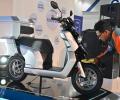
as the FAME II deadline of March 31, 2024, nears, EV manufacturers are worried about their investments and future plans.

Major two-wheeler manufacturers in India witnessed a double-digit increase in domestic sales in October, driven by the festival fervour.

'...the auto industry to get back to 7% to 8% annual growth.' 'High growth in the SUV segment alone will not achieve this, as it is a small market.'

'Today, we have 2 million active drivers earning through our platform every month.'
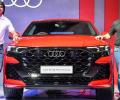
Audi plans to focus the Indian market, including deepening market penetration and increasing sales volume.

Driven by a rise in sales during the current year, German luxury carmaker Mercedes-Benz said on Thursday that the company is expecting a growth in sales of around 8-10 per cent in the next few years. This comes at a time when the company is ready to surpass the previous highest sales of 15,538 vehicles (2018) in 2022. During the first half, the company sold 7,600 units. It already has an order bank of around 7,000 vehicles. In 2021, the company sold 11,242 vehicles.
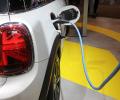
Maruti Suzuki India will launch electric vehicles in the country only after 2025 as demand for such vehicles at the moment is less and it would like to sell around 10,000 units a month whenever it enters the electric mobility space, company chairman RC Bhargava said on Wednesday. Addressing a virtual conference on the company's second quarter earnings, he said under the current circumstances a lot of things in the EV ecosystem such as batteries, charging infrastructure and electric supply are done by other parties and therefore the costing is not in the hands of the company. Also with fuel prices going up, car market leader Maruti Suzuki India is intensifying its focus on more CNG offerings of its models.

This is not the first EV that Mercedes would be making in India though. It has been making the EQS sedan here for the last 18 months, and has sold 500 units of the car.

Bajaj Auto has become the top player in India's electric vehicle market by monthly volumes, across all categories, with over 25,000 sales and registrations in September. This comes on the back of a big push in expanding distribution by the company and steady demand of electric three-wheelers. In September, the company - according to the latest Vahan data - recorded sales of 17,570 electric two-wheelers, 4,575 three-wheelers, and 3,000 Yulu low-speed electric bikes (based on company sales numbers), which do not require a licence and are not registered on Vahan.

Maruti Suzuki India (MSIL) said on Thursday its operations are unaffected by the global rare earth magnet shortage, but added that the situation is "uncertain and evolving". The firm said it is exploring multiple solutions to maintain continuity in operations and will notify stakeholders in case of material impact.
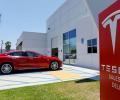
Union Minister Nitin Gadkari on Friday said he has asked US-based Tesla several times to manufacture its iconic electric vehicles in India, while assuring that all support will be provided by the government to the company. Addressing 'India Today Conclave 2021', Gadkari further said electric cars manufactured by Tata Motors are not less good than electric cars manufactured by Tesla. "I have told Tesla that don't sell electric cars in India which your company has manufactured in China.

For FY26, the company has adopted a cautious outlook, anticipating domestic growth to broadly track the industry's low single-digit estimated growth amid ongoing economic headwinds.

Earlier in May, Ford India announced that it had dropped its plans to make electric vehicles (EVs) in India, which it intended to export, under the production-linked incentive scheme (PLI). Ford was among 20 companies that had signed a Champion OEM Incentive Scheme under the PLI project with the government in February this year. The decision comes as a blow for the 4,000-odd employees at Ford India's Maraimalai Nagar plant near Chennai and in Sanand, Gujarat. In September last year, the company had announced that it would exit the India market, which it had entered in 1995 through an on-again, off-again joint venture with Mahindra & Mahindra (they split in 1998, signed a JV in 2019 and split again in December 2020), retailing petrol and diesel brands such as the EcoSport, Figo, Aspire, and Endeavour.
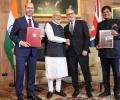
'That way you're not hostage just to US sort of exports to India.'
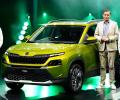
The auto major is not just looking at domestic sales, but also planning to ramp up exports to key markets from here, like the Middle East, North Africa and Australia.

Honda Motorcycle and Scooter India (HMSI), India's second-largest two-wheeler maker, on Wednesday revealed its electric vehicle (EV) roadmap, which includes setting up a dedicated EV factory, launching the first two EVs in 2023-24, and establishing 6,000 battery exchange points in the country. HMSI plans to establish a specialised unit for the manufacturing of electric vehicles (EVs), named 'Factory E', at its Narsapura plant located in Karnataka. Factory E will be created by converting an existing production line that currently manufactures internal combustion engine (ICE) vehicles, said Atsushi Ogata, HMSI managing director and chief executive officer.

To help you ride the growth trajectory of India's equity markets, we have curated the top five fastest-growing stocks that hold an impressive upside. If you're planning to build a sound portfolio and capitalize on the growth of these leading institutions, it's time you watch these stocks.

Auto manufacturers have focused on launching CNG variants of their popular models to meet consumer demand for vehicles with lower running costs.
'Every Indian should move to an EV, and the government should not buy any fossil fuel cars. The government should become the first driver of EV adoption.'

India will never provide company or enterprise-specific incentives in the electric vehicle sector, a top government official said on Friday, amid a push from American electric carmaker Tesla for special sops to set up its factory in the country. If the government has to consider providing incentives then it will only be for all EV makers and entrants who want to come to India, the official said. The official added that inter-ministerial discussions have happened on the customs duty concession demand of the US-based electric car maker Tesla, but "we never" came to any conclusion on those.
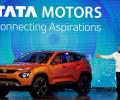
Notwithstanding robust volume growth and a strong performance from Jaguar Land Rover (JLR), Tata Motors, the country's second-largest automobile (auto) manufacturer by market capitalisation, disappointed the Street with its January-March quarter (Q4) results for 2023-24 (FY24). While consolidated revenues saw a 13 per cent increase, lower-than-expected realisations in the Indian operations weighed down overall performance.
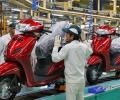
Honda Motorcycle and Scooter India (HMSI), the country's second-largest two-wheeler manufacturer, is planning to launch its first electric vehicle (EV) here by March next year, said CEO & MD Atsushi Ogata on Monday. The company would also enter the low-end motorcycle market in March by launching a 100cc engine bike at a price that will "positively shock" customers, he said while speaking with reporters, after launching the Activa with Honda Smart Key. HMSI's first EV, an electric scooter, will have a fixed battery and the second model will have two swappable batteries, Ogata explained.

The Rs 1-trillion Research Development and Innovation (RDI) fund, which was announced in the July budget for FY25, of which Rs 20,000 crore has already been allocated, will be operationalised in the next two to three months, a top official said.

The promoter entities of JSW Group are in talks with several electric-car manufacturers in China to launch an electric car for the Indian market at Rs 15-20 lakh, a source close to the development said.

'If it is your second car (electric vehicle), you typically keep it for travel within the city.' 'And the first car (internal combustion engine-run vehicles) can then be used to travel to some other cities.'

India has a history of jugaad, and retrofitting vehicles is one such manifestation of the legendary Indian skill. Not so long ago autorickshaws and small Marutis used to strap on subsidised LPG cylinders and power themselves to a cheap ride. There were the odd explosions, lives were lost, but the jugaad continued. Then compressed natural gas (CNG) was introduced in Delhi following a court order. Initially, customised CNG kits were fitted to conventional (internal combustion engine or ICE) autos cheaply, enabling commuting at less than half of what you would cough up for diesel. The industry is better organised now with Suzuki and Hyundai designing CNG-fired vehicles, and Mahindra and TVS manufacturing liquefied petroleum gas (LPG)-powered three wheelers.

The 17 rare earth elements that are at the centre of the current crisis are critical components of everyday products -- from cars to jet engines to electronics like smartphones and flat-screen TVs.

'We are very quickly going to announce the timeline of our launches, which should start giving us the turnaround'
